Bull Put Spread: how it works, with an example
You sell a put and buy one lower down as protection. You collect money up front and profit if the stock does not fall.
What is a bull put spread?
A bull put spread is made of two puts on the same stock, with the same expiry: you sell one and buy another with a lower strike.
The put you sell brings in a premium. The one you buy costs less and limits your loss if the stock falls. You keep the difference between the two if the stock is above the higher strike at expiry.
You do not need a rise: you only need the stock not to fall.
Bull Put Spread calculator
It starts from an example with simple numbers: a stock at $100 and options that expire in 30 days. Change the price, the strikes and the premiums to see your own case.
Today
Change the numbers
Sell 1 put
you collect $325
Buy 1 put
you pay $135
Options expire in 30 days, one contract is 100 shares. Nothing is saved: the numbers stay in your browser.
- You collect
- $190
- Maximum profit
- $190
- Maximum loss
- $310
- Breakeven at expiry
- $98.10
- Chance of profit
- 59%an estimate at expiry, from the volatility implied by the premiums
The example, step by step
The stock is at $100. You sell a put with a $100 strike and collect $325; you buy a put with a $95 strike and pay $135. Both expire in 30 days. In total you collect $190.
If the stock is at $100 or above at expiry, both puts are worth nothing and that $190 is your maximum profit.
If it falls, you start losing below $98.10. The put you bought stops the damage at $95: below that the loss does not grow, and the most you can lose is $310.
In the app, the Strategy Builder does much more
The calculator above is a simplified version, made to understand Bull Put Spread with easy numbers. In Gaudio OTT you build it on real market prices, on the stock, ETF, index or future you choose, in two ways.
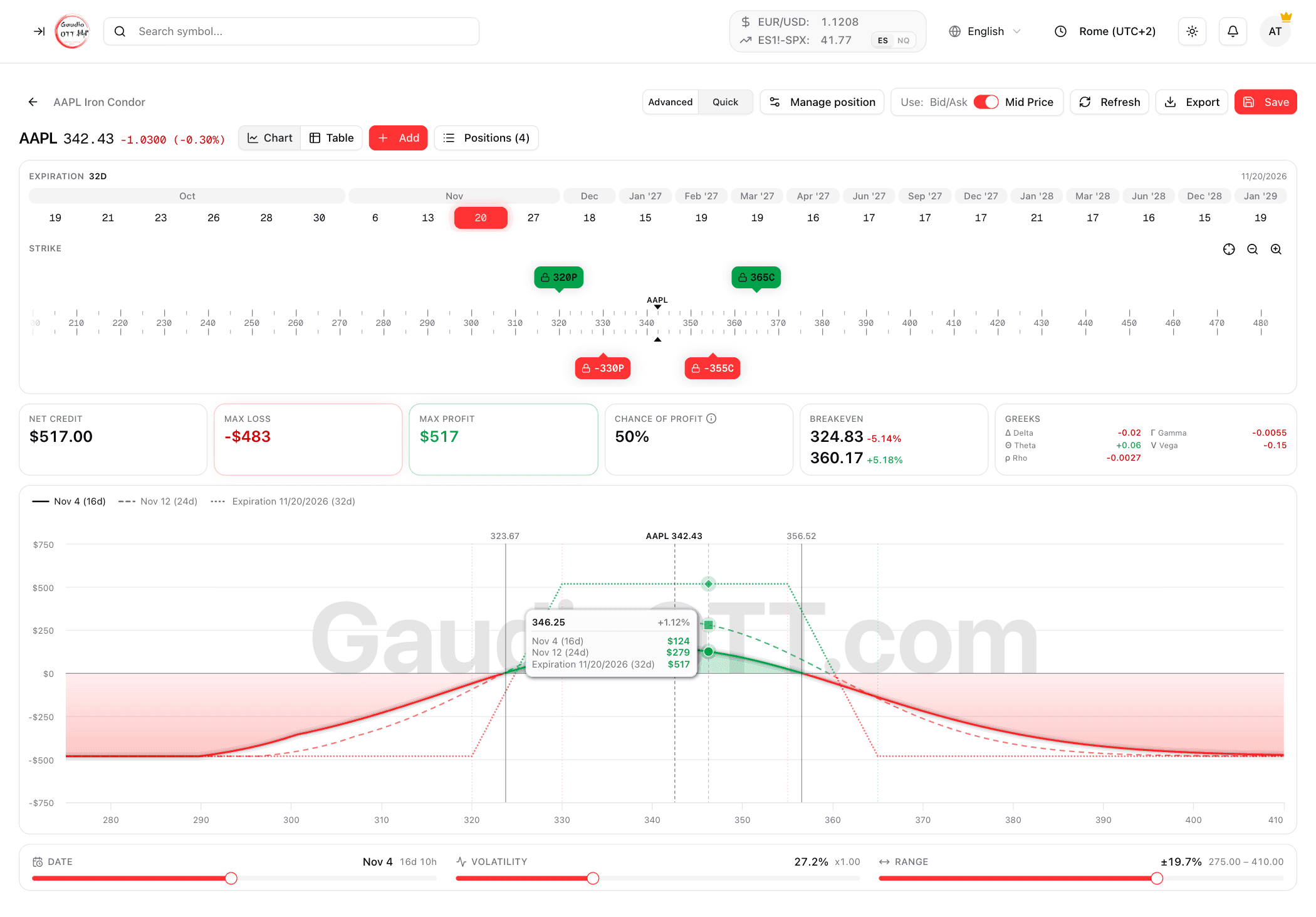
Quick mode
Pick the expiration, drag the legs along the strike ruler and read net credit or debit, maximum loss and profit, chance of profit, breakevens and Greeks as you move them.

Advanced mode
Start from the full options chain with the Greeks of every strike, simulate time, price and volatility, then save the strategy and follow it day by day in your portfolio.
When it makes sense
- You think the stock will stay flat or rise.
- You want to collect a premium with a maximum loss known from the start.
- You want to tie up less money than someone selling a put on its own.
When to avoid it
- You fear a fall in the short term.
- You expect a strong rise: the profit is capped here.
- You cannot accept losing more than you can collect.
What can go wrong
The risk is a fall. In the example you collect $190 if it works and lose up to $310 if it does not: the maximum loss is larger than the maximum profit.
If the stock is between the two strikes at expiry, the put you sold can be exercised and you end up with 100 shares. To avoid that, the spread is usually closed before expiry.
How it is managed in practice
The distance between the two strikes decides how much you risk: the closer they are, the less you can lose and the less you collect. Start from the maximum loss you are willing to accept, not from the premium.
It is often closed before expiry, once most of the premium has been collected. Holding the spread to the last day for a few more dollars exposes you to a risk that is usually not worth it.
The most common mistake
Looking only at how often you win. You win often, but one full loss is worth more than one full win: without a rule for closing, a single time is enough.
Try Bull Put Spread with real market prices
In the Gaudio OTT simulator you build this strategy on the stock you choose, at market prices, and see how it evolves day by day. No order is sent: run as many trials as you like.
Try it in the simulatorThe Strategy Builder is part of the Strategy and Ultra plans, with a 7-day free trial on monthly plans.
Bull Put Spread: frequently asked questions
Reviewed by the Gaudio OTT team
The numbers on this page are a teaching example, not market quotes or a forecast.
Start analyzing options like a professional
Implied volatility, GEX, open interest and volume, proprietary indicators, AI Scanner and a multi-leg strategy builder: every options trading analysis tool in one platform.
Free plan, no credit card · 7-day trial on monthly plans · Cancel anytime
Questions?