Iron Condor: how it works, with an example
With an iron condor you profit if the stock stays inside a price range. You collect money up front and know from the start how much you can lose.
What is an iron condor?
An iron condor is made of four options on the same stock, with the same expiry. You sell two close to the current price, one below and one above, and buy two further away that act as protection.
You collect more from the two options you sell than you spend on the two you buy. You keep the difference if the stock is still between the two sold prices at expiry.
It is a strategy for quiet markets: you do not have to guess whether the stock goes up or down, you only need it not to move too much.
Iron Condor calculator
It starts from an example with simple numbers: a stock at $100 and options that expire in 30 days. Change the price, the strikes and the premiums to see your own case.
Today
Change the numbers
Buy 1 put
you pay $40
Sell 1 put
you collect $135
Sell 1 call
you collect $165
Buy 1 call
you pay $65
Options expire in 30 days, one contract is 100 shares. Nothing is saved: the numbers stay in your browser.
- You collect
- $195
- Maximum profit
- $195
- Maximum loss
- $305
- Breakeven at expiry
- $93.05 $106.95
- Chance of profit
- 58%an estimate at expiry, from the volatility implied by the premiums
The example, step by step
The stock is at $100. You sell a put with a $95 strike and a call with a $105 strike; you buy a put with a $90 strike and a call with a $110 strike. They all expire in 30 days. In total you collect $195.
If the stock is between $95 and $105 at expiry, the four options are worth nothing and that $195 is your profit. It is also the most you can make.
If the stock leaves the range you start losing: below $93.05 or above $106.95 you are at a loss. The two options you bought stop the damage, though, and the worst that can happen is losing $305.
In the app, the Strategy Builder does much more
The calculator above is a simplified version, made to understand Iron Condor with easy numbers. In Gaudio OTT you build it on real market prices, on the stock, ETF, index or future you choose, in two ways.
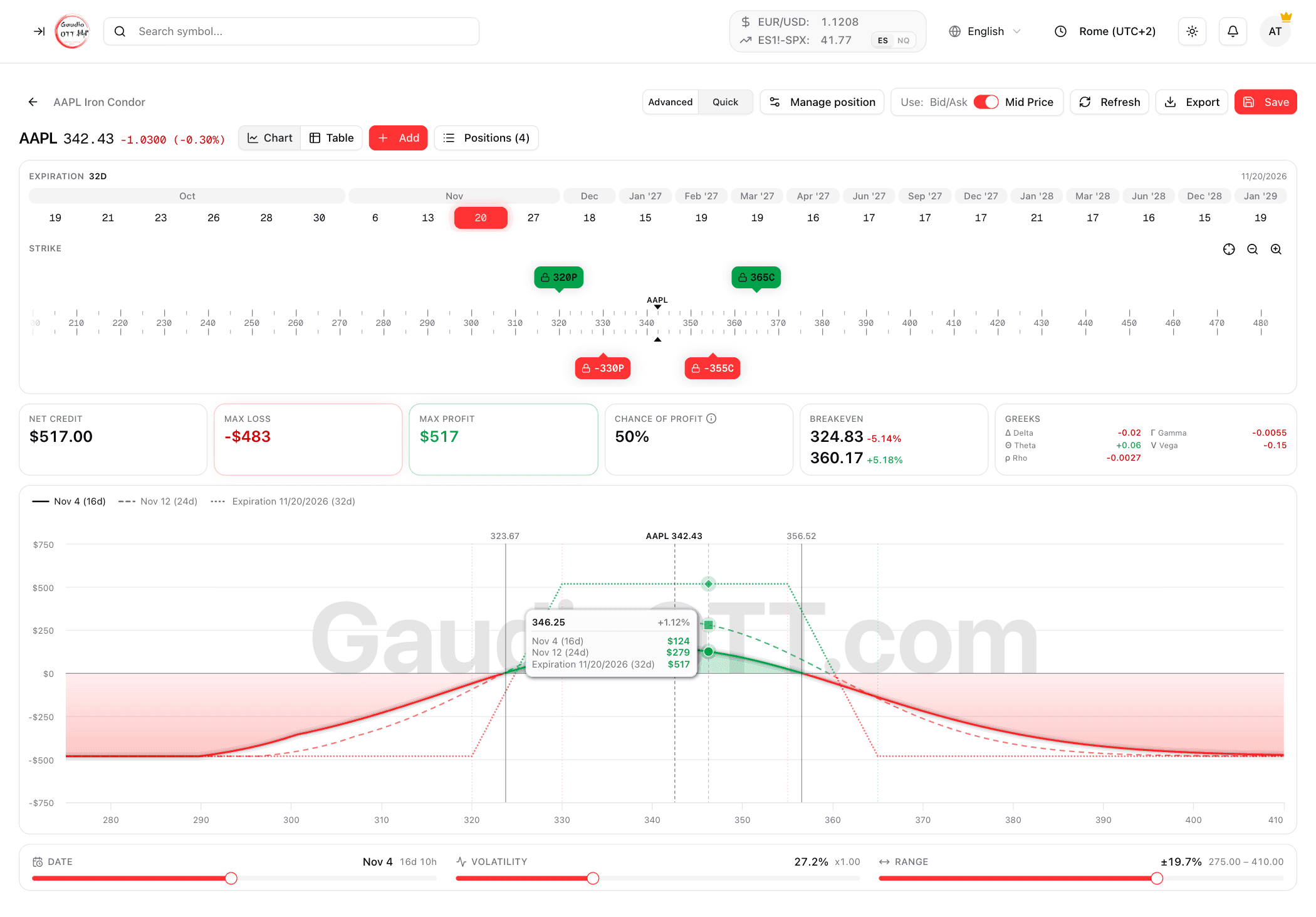
Quick mode
Pick the expiration, drag the legs along the strike ruler and read net credit or debit, maximum loss and profit, chance of profit, breakevens and Greeks as you move them.

Advanced mode
Start from the full options chain with the Greeks of every strike, simulate time, price and volatility, then save the strategy and follow it day by day in your portfolio.
When it makes sense
- You expect the stock to stay still, or nearly so, until expiry.
- You prefer small, frequent gains to large, rare ones.
- You want a maximum loss fixed from the start.
When to avoid it
- News that can move the stock a lot is coming, such as quarterly earnings.
- The stock is already trending strongly, up or down.
- You cannot accept losing more when it goes wrong than you collect when it goes right.
What can go wrong
The risk is a large move. In the example you collect $195 when it works and lose up to $305 when it does not: a single full loss wipes out more than one win.
That is why many traders close an iron condor before expiry, once they have collected most of the premium or when the stock gets close to one of the two sold prices.
How it is managed in practice
The strikes you sell go outside the range where you expect the stock to stay. The further out you place them, the more likely you are to profit and the less you collect.
It is usually used on indices or heavily traded stocks, and not held through events such as quarterly earnings. Many traders close it once they have collected about half the premium, without waiting for expiry.
The most common mistake
Doing nothing when the stock gets close to one of the strikes you sold. That is when the loss grows fastest: you need a rule decided beforehand, not hope.
Try Iron Condor with real market prices
In the Gaudio OTT simulator you build this strategy on the stock you choose, at market prices, and see how it evolves day by day. No order is sent: run as many trials as you like.
Try it in the simulatorThe Strategy Builder is part of the Strategy and Ultra plans, with a 7-day free trial on monthly plans.
Iron Condor: frequently asked questions
Reviewed by the Gaudio OTT team
The numbers on this page are a teaching example, not market quotes or a forecast.
Start analyzing options like a professional
Implied volatility, GEX, open interest and volume, proprietary indicators, AI Scanner and a multi-leg strategy builder: every options trading analysis tool in one platform.
Free plan, no credit card · 7-day trial on monthly plans · Cancel anytime
Questions?