Straddle: how it works, with an example
You buy a call and a put with the same strike. You profit if the stock moves a lot, either way; you lose if it stays still.
What is a straddle?
A straddle is made of two options you buy on the same stock, with the same strike and the same expiry: a call, which makes money if the stock rises, and a put, which makes money if it falls.
You do not have to guess the direction. You do need a large move, though, because you pay two premiums and the stock has to move enough to pay for both.
It is often used before an event with an uncertain outcome, such as a company's quarterly earnings.
Straddle calculator
It starts from an example with simple numbers: a stock at $100 and options that expire in 30 days. Change the price, the strikes and the premiums to see your own case.
Today
Change the numbers
Buy 1 call
you pay $360
Buy 1 put
you pay $325
Options expire in 30 days, one contract is 100 shares. Nothing is saved: the numbers stay in your browser.
- You pay
- $685
- Maximum profit
- unlimited
- Maximum loss
- $685
- Breakeven at expiry
- $93.15 $106.85
- Chance of profit
- 42%an estimate at expiry, from the volatility implied by the premiums
The example, step by step
The stock is at $100. You buy a call and a put, both with a $100 strike and expiring in 30 days. The call costs $360, the put $325: in total you spend $685.
That $685 is the most you can lose, and it is what happens if the stock is exactly at $100 at expiry.
To profit, the stock has to be below $93.15 or above $106.85 at expiry. Beyond those two prices, the further the stock goes the more you make.
In the app, the Strategy Builder does much more
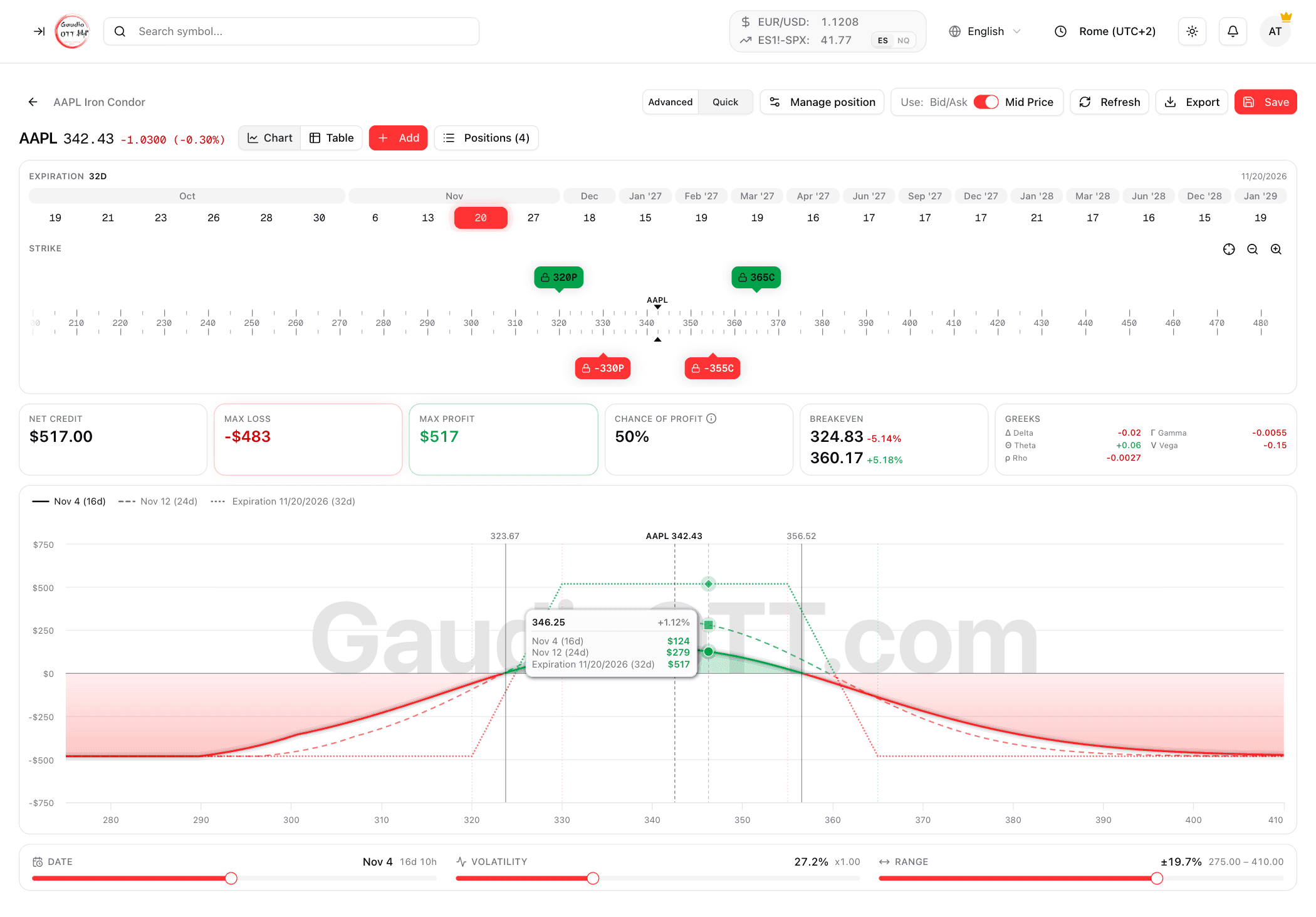
The calculator above is a simplified version, made to understand Straddle with easy numbers. In Gaudio OTT you build it on real market prices, on the stock, ETF, index or future you choose, in two ways.
Quick mode
Pick the expiration, drag the legs along the strike ruler and read net credit or debit, maximum loss and profit, chance of profit, breakevens and Greeks as you move them.

Advanced mode
Start from the full options chain with the Greeks of every strike, simulate time, price and volatility, then save the strategy and follow it day by day in your portfolio.
When it makes sense
- You expect a big move but do not know which way.
- Important news for the stock is about to come out.
- You want a maximum loss fixed from the start.
When to avoid it
- You think the stock will stay still.
- Options are already very expensive because everyone expects the same move.
- The event you are waiting for is far off: meanwhile time eats into both premiums.
What can go wrong
The risk is that nothing happens. With the stock standing still, both options lose value every day and at expiry you can lose up to $685.
There is also a less obvious risk: after expected news, options suddenly become cheaper again. The stock can move and the straddle still be worth less than you paid for it.
How it is managed in practice
The cost of the two premiums tells you how much movement the market is already pricing in. A straddle makes sense if you think the stock will move more than that.
It is usually bought a few days before the event, not at the last moment, and closed right after: once the news is out, options lose value quickly.
The most common mistake
Buying it the day before news that everyone is waiting for. Premiums are already inflated, and after the announcement they deflate even if the stock moves.
Try Straddle with real market prices
In the Gaudio OTT simulator you build this strategy on the stock you choose, at market prices, and see how it evolves day by day. No order is sent: run as many trials as you like.
Try it in the simulatorThe Strategy Builder is part of the Strategy and Ultra plans, with a 7-day free trial on monthly plans.
Straddle: frequently asked questions
Reviewed by the Gaudio OTT team
The numbers on this page are a teaching example, not market quotes or a forecast.
Start analyzing options like a professional
Implied volatility, GEX, open interest and volume, proprietary indicators, AI Scanner and a multi-leg strategy builder: every options trading analysis tool in one platform.
Free plan, no credit card · 7-day trial on monthly plans · Cancel anytime
Questions?